A project engineer asks which specification applies to a drawing that changed yesterday. A data analyst needs to find sensitive information scattered across thousands of files. A runner opens a wellness app and wants to understand how this week’s activity compares with their usual pattern. Each task can benefit from AI, but each requires a different kind of product.
At Newsoft, our designers and engineers in Lviv have worked on document-based AI assistants, language-model integrations for data classification, personalised insights from wearable data, conversational memory, and image analysis in mobile apps. Our role has ranged from owning integrations inside a client’s engineering team to designing and delivering an entire application around an AI capability.
Answering questions from company documents
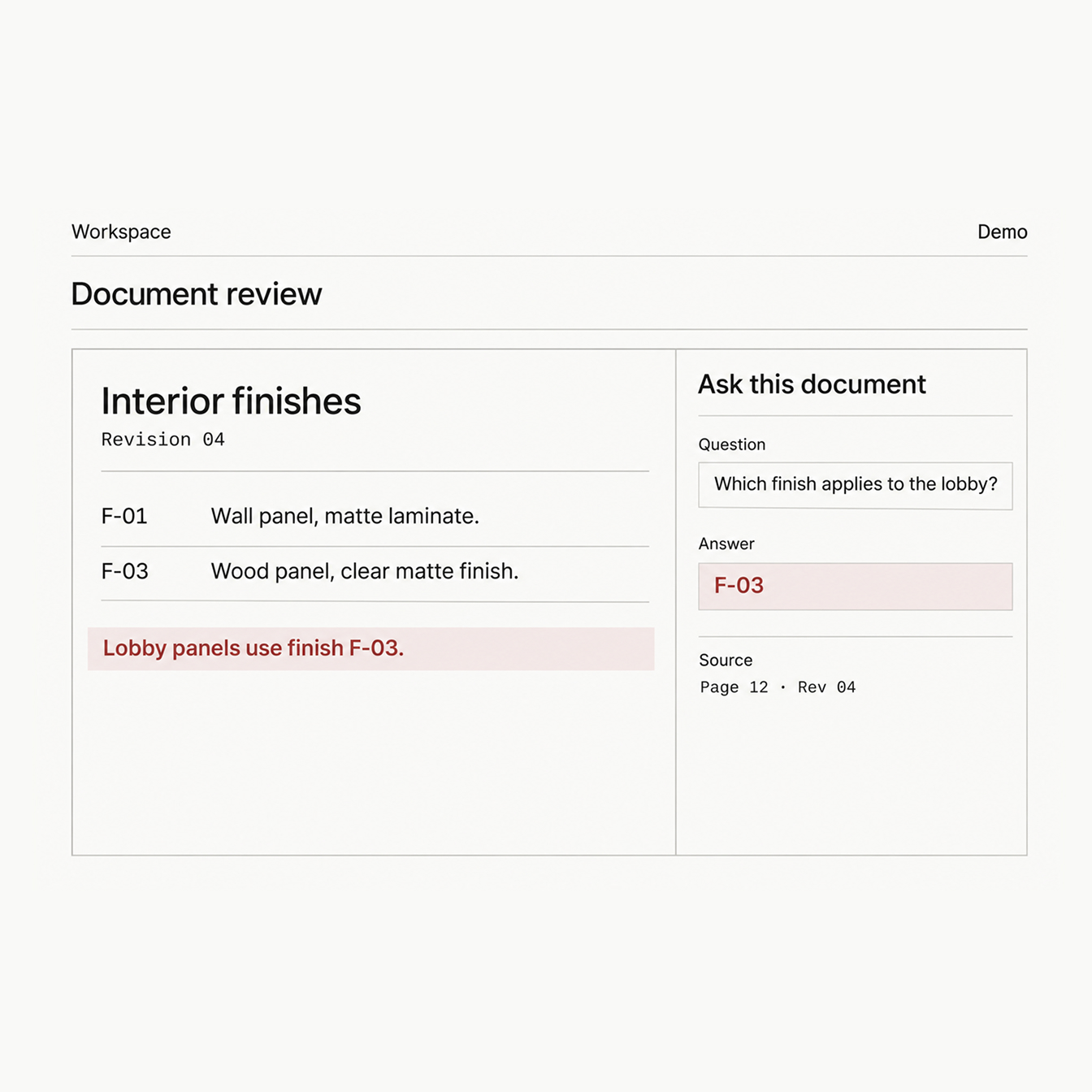
Consider a construction team working with drawings, specifications, and internal standards. Someone looking for a requirement may know the project and the question, but have no idea which file contains the answer. A document assistant lets them ask in their own words. The product retrieves relevant material from connected files and supplies it to a language model to compose an answer. This approach is called retrieval-augmented generation, or RAG.
On an enterprise AI platform, our embedded team took ownership of the integrations that make those documents available to the assistant. Customers kept files in systems including Google Drive, SharePoint, Egnyte, and Autodesk Construction Cloud. Each provider has its own way of authorising access and reporting changes. We worked on a common integration layer that brought those sources into the platform. It combined update notifications, periodic checks, and recovery after interrupted synchronisation.
That engineering affects the substance of the answer. Suppose a project manager replaces a specification on Monday. On Tuesday, a colleague asks about the revised requirement. The model could accurately summarise the passage it received and still give the wrong answer for Tuesday if the connector supplied Friday’s version. To investigate that answer, an engineer needs to work backwards: which passage reached the model, which version contained it, and when did the source last sync? Each question points to a different part of the system and a different fix.
Our product design work also covered how people manage files, conversations, and workflows. For a workflow that can take action, configuration and execution were separate steps. This gives someone setting up a review a chance to examine the instructions before running it. The client’s engineers retained ownership of the core platform while our specialists worked alongside them on design and the integration roadmap.
Classifying sensitive information across data sources
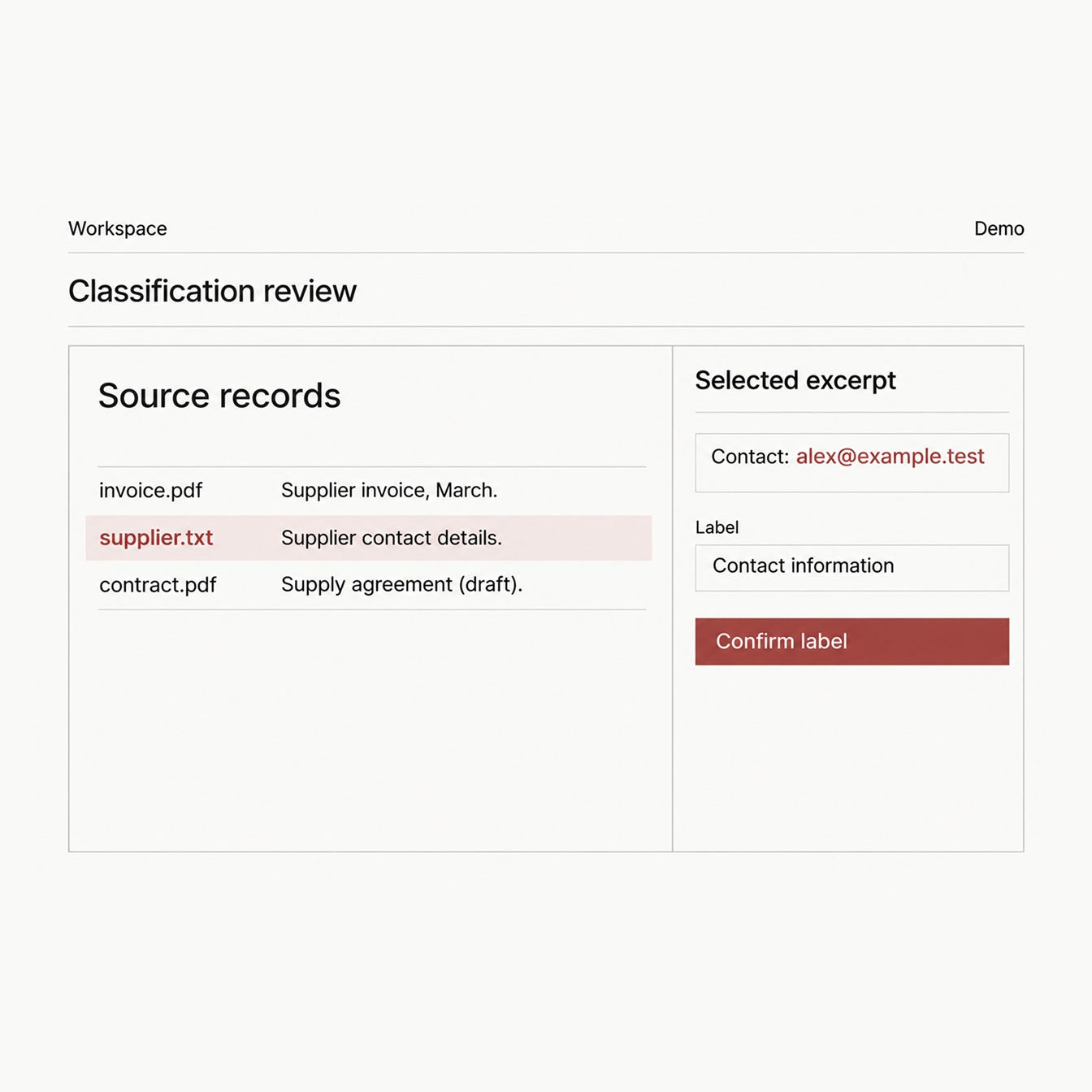
A classification feature answers a different question: “What kind of information is in this file, and how can I find other records like it?” Its output needs to work as a category someone can search or filter. A well-written paragraph about a document would be a poor substitute for a consistent label across a collection.
We contributed to a data governance product that scans unstructured information in cloud and on-premises systems. The platform uses machine learning and natural language processing to discover, classify, and redact sensitive data. Our part included building connectors for additional sources, introducing support for multiple large language models in the categorisation process, and implementing a custom query language. These pieces address different stages of the analyst’s task: getting a collection into the system, categorising its contents, and finding relevant records afterwards.
There is also a difference between an unclassified file and a file that has yet to be processed. Both might be absent from a search result, but they call for different action. We implemented explicit processing states for jobs, with RabbitMQ carrying messages between stages. That work gave the application a way to track a scan as it progressed. For a team planning a similar feature, this is worth specifying early: what should an analyst be able to conclude from an empty result?