This site uses cookies

Accept

Icon
Icon
2
Explore our pages
Icon
Home
[01]
About
[02]
Cases
[03]
News
[04]
Contact
[05]
Contact
[05]
Social
Instagram
LinkedIn
Clutch
Medium

AI Multiplies Engineering Speed. Without Shared Rules, It Multiplies Chaos.

Category:
Digests
Date:
November 24, 2026

A field note from Oleh Roshka, CTO and Co-Founder at Newsoft, on AI-assisted development, the review burden it creates, and the shared rules that help teams deliver reliably.

‍

‍AI is often discussed as a tool for writing code faster. Leading an engineering team, I find the more useful question is how much work remains before we can trust that code and merge it into the existing system.

‍

AI can accelerate architecture, implementation, testing, and review. But faster generation does not automatically mean faster delivery. What matters is what engineers delegate, what context they provide, and what the team checks before accepting the result.

‍

The opportunity is real. So is the possibility of moving work from one person’s coding session into everyone else’s review queue.

‍

The new bottleneck is making changes production-ready

‍

AI makes it easy to generate feature concepts, prototypes, and initial implementations. Turning them into production-ready changes still requires:

‍

  • Integration with the existing system.
  • Architecture and security validation.
  • Realistic edge-case handling.
  • Tests and regression coverage.
  • Analytics and monitoring where needed.
  • Rollout and rollback planning.
  • Documentation and long-term ownership.
    ‍

AI can accelerate these activities, but it does not eliminate them. The final stretch of delivery is often where much of the risk and effort remains. For a team, this raises a practical question: has AI reduced the total effort, or simply moved it from writing code to reviewing and correcting it?

‍

In our case, AI clearly speeds us up when the team is aligned on review standards, testing, integration, and what “done” means.

‍

«Without that alignment, the time saved writing code can disappear into review and rework.»

Oleh Roshka, CTO & Co-Founder

‍

One example made this particularly clear. A product-oriented teammate used AI to turn a design fix into a working pull request (PR). It addressed a real problem: a UI state that was otherwise unusable. The intent was right, and the initiative was valuable.

‍

But the PR contained over 2,000 changed lines, accompanied by a long AI-generated description. It also touched an area another engineer already owned and was actively working on. Reviewing it took far more effort than writing the equivalent code from scratch would have. The description focused on the AI’s reasoning rather than the information a reviewer needed to assess the change. Its size made it difficult to identify which changes were essential, and the team had to pause planned work to review something that had arrived without warning.

‍

The problem was the absence of shared expectations about what kind of contribution this was and what the team was expected to do with it.

Two kinds of PRs, two different expectations

‍

Our response was to distinguish between two kinds of PRs. This gives people room to contribute ideas while making the review expectations clear.

‍

Intent PR: demonstrate an idea

‍

An intent PR shows how a proposed change could look or behave. It attaches to a ticket as reference material and helps the team discuss the idea.

‍

It is not intended to be merged, so it does not go through production code review. The owning engineer plans and builds the production implementation from scratch, using the intent PR as a guide.

‍

That distinction matters. A useful demonstration can communicate a product idea without creating an immediate obligation to review and maintain the code behind it.

‍

Production PR: prepare a change to ship

‍

A production PR requires a full review and must meet our normal team expectations and PR template: a clear description, relevant screenshots, an explanation of the impact, and appropriate tests.

‍

The basics still apply. The design needs to be current, the team needs advance notice, and there needs to be a ticket with a clear owner.

‍

We strongly encourage non-technical contributors to keep these PRs small and precise, limited to specific UI or business-logic changes. For these contributions, we set a cap of 200 changed lines. The scope and risk still need review.

‍

Without this distinction, a team already running at full capacity struggles to plan around incoming contributions. A large, unexpected PR displaces work the team has already committed to delivering and affects the people counting on it.

‍

We are now making this distinction part of our workflow so that contributors and reviewers share the same expectations before the next large AI-assisted PR arrives.

Rapid prototyping: the greatest value beyond coding

‍

Rapid prototyping is one of the areas where I see the greatest value from AI. A team can turn an early idea into something tangible much sooner. Instead of discussing an abstract concept, we can put an interactive prototype in front of users, designers, and stakeholders. In our work, Claude Design and Figma prototyping have been particularly useful here.

‍

When AI has access to the project’s design system, it can produce prototypes that follow existing components, visual patterns, and brand guidelines. I find this especially useful for familiar UX patterns, such as admin panels. AI can quickly lay out the expected flows and screens, allowing the team to spend more design effort on what is specific to the product.

‍

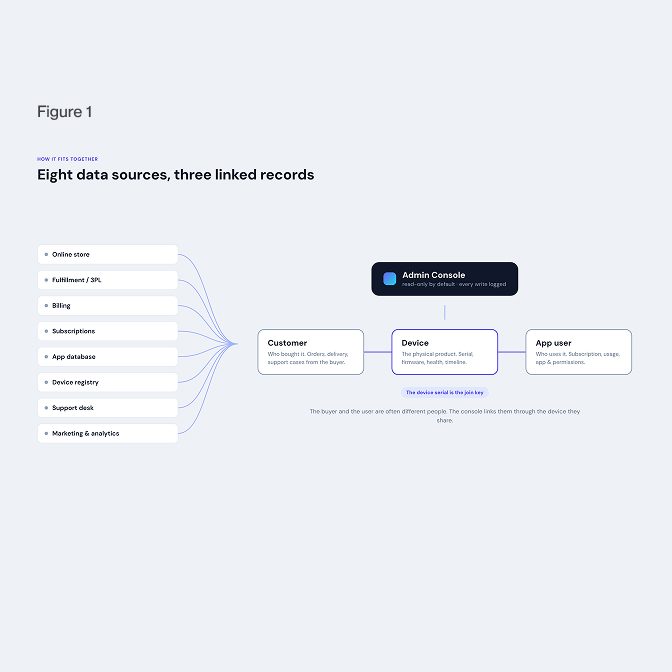
For example, we laid out a complex internal admin panel in days rather than weeks. It brought together data from marketing, product, customer experience, shipments, and third-party logistics partners, grouped around the needs of each team.The prototype showed how eight data sources would connect around three linked records: the customer, the device, and the app user (Figure 1).
‍

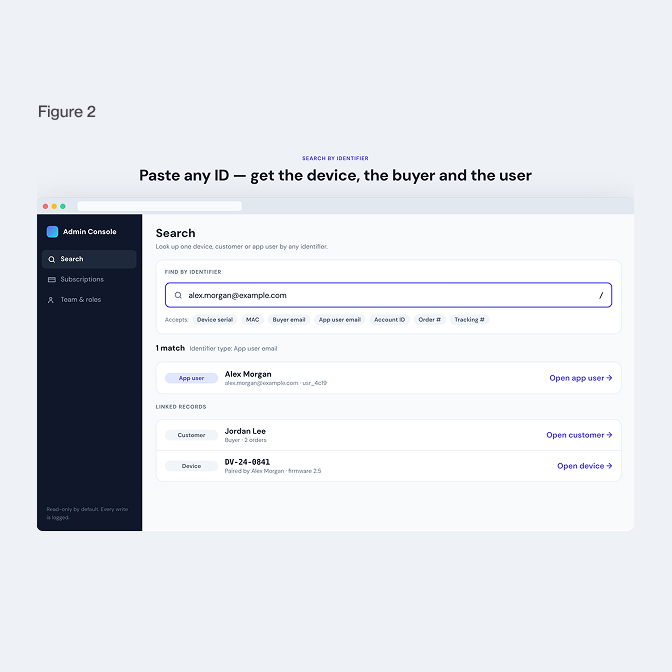
The search flow showed how a team member could look up a record using an identifier, such as an email address or device serial, and find the related customer, device, and app user (Figure 2). A dedicated device screen brought together purchase details, the current owner, firmware and health information, a device timeline, ownership history, and support cases (Figure 3).
‍

That gave us something concrete to discuss before committing to full implementation. We could examine how information was organised, identify weak assumptions, and explore alternatives early. The broader process from the scope document to a build-ready plan took about two weeks and produced 16 interactive screens, 43 reusable components, more than 140 design iterations with the client, and one product requirements document split into two releases (Figure 4).

‍

In one wellness product, our team went from zero to a working product in six months, and AI shaped how we started. It helped us analyse competitors and review customer feedback on their products, grounding our early decisions in evidence. From there, rapid prototyping in Claude Design let us test ideas early and move quickly from concept to something people could use. AI also supported the implementation work, carrying that speed into building the product itself.

‍

Personally, this has changed how I prepare for product discussions. I can create clearer product requirements documents, build interactive prototypes, and visualise ideas in minutes rather than spending hours explaining them. The value comes from shortening the distance between an idea and useful feedback. An intent prototype gives the team something to evaluate while keeping the production decision separate.

No items found.

Human oversight should follow the cost of failure

‍

The greater the impact of a potential failure, the stronger the human oversight should be. I'm comfortable giving engineers and non-technical contributors more freedom to use AI for exploratory work: prototyping a UI, trying a layout for an admin panel, or demonstrating how a fix could look.

‍

Once a change is intended for production, the expectations change. Security, payments, sensitive data, core business logic, concurrency, and performance all require closer validation. Shared components need particular care because other people already own and depend on them.

‍

This does not mean engineers must manually write every critical line. AI can propose, implement, test, and review a solution. The engineer’s responsibility is to understand it, challenge its assumptions, and verify that it is ready for production.

‍

One pattern I regularly see in review is overly defensive code. AI often adds fallbacks, checks, abstractions, and error branches for hypothetical conditions that cannot occur under the actual system design. The result looks robust at first, but it can be harder to read, test, modify, and debug.

‍

Defensive programming remains essential at system boundaries: user input, networks, external services, storage, and other unreliable sources. Inside a controlled system, however, speculative fallbacks can hide violations of assumptions the system relies on. Every unnecessary branch becomes another behaviour the team has to understand and maintain.

‍

The review question should therefore include both “Have all relevant cases been handled?” and “Can these cases actually occur?” Answering those questions requires knowledge of the system, not just an inspection of the generated code.

‍

From individual workflows to shared rules

‍

The most common risk I see is engineers building separate AI workflows without shared rules. One maintains careful instructions, another uses a different agent, and a third accepts generated code with little review.

‍

Individual tasks get faster while the codebase becomes less consistent. Abstractions are duplicated, patterns diverge, and checks accumulate around states that cannot occur. The code may still work, but subsequent changes become harder.

‍

Coding standards, architecture conventions, security requirements, testing, and review become more important as code generation speeds up. Teams need a way to turn useful individual practices into shared instructions available to both engineers and coding agents.

‍

In our team, those instructions live in the repository alongside the code. CLAUDE.md files hold project conventions. We also maintain reusable Claude skills: Markdown instructions for workflows the team performs repeatedly, such as preparing a PR using our template or reviewing a change for operational safety.

‍

When one engineer improves these instructions, the rest of the team gets the update when they pull the latest changes. This gives us a shared starting point while leaving room to experiment and improve the workflow. But conventions alone are not enough. Shared rules tell an agent how we expect changes to be made. They do not, on their own, explain how the system fits together.

No items found.

Giving agents a map of the codebase

‍

To address that gap, we built a knowledge graph skill. Without explicit project context, a coding agent may begin a task with only a partial view of the codebase. It may not know where a feature lives, which services depend on it, or whether a helper for the same job already exists. It can search a few files and still miss the relationships that matter.

‍

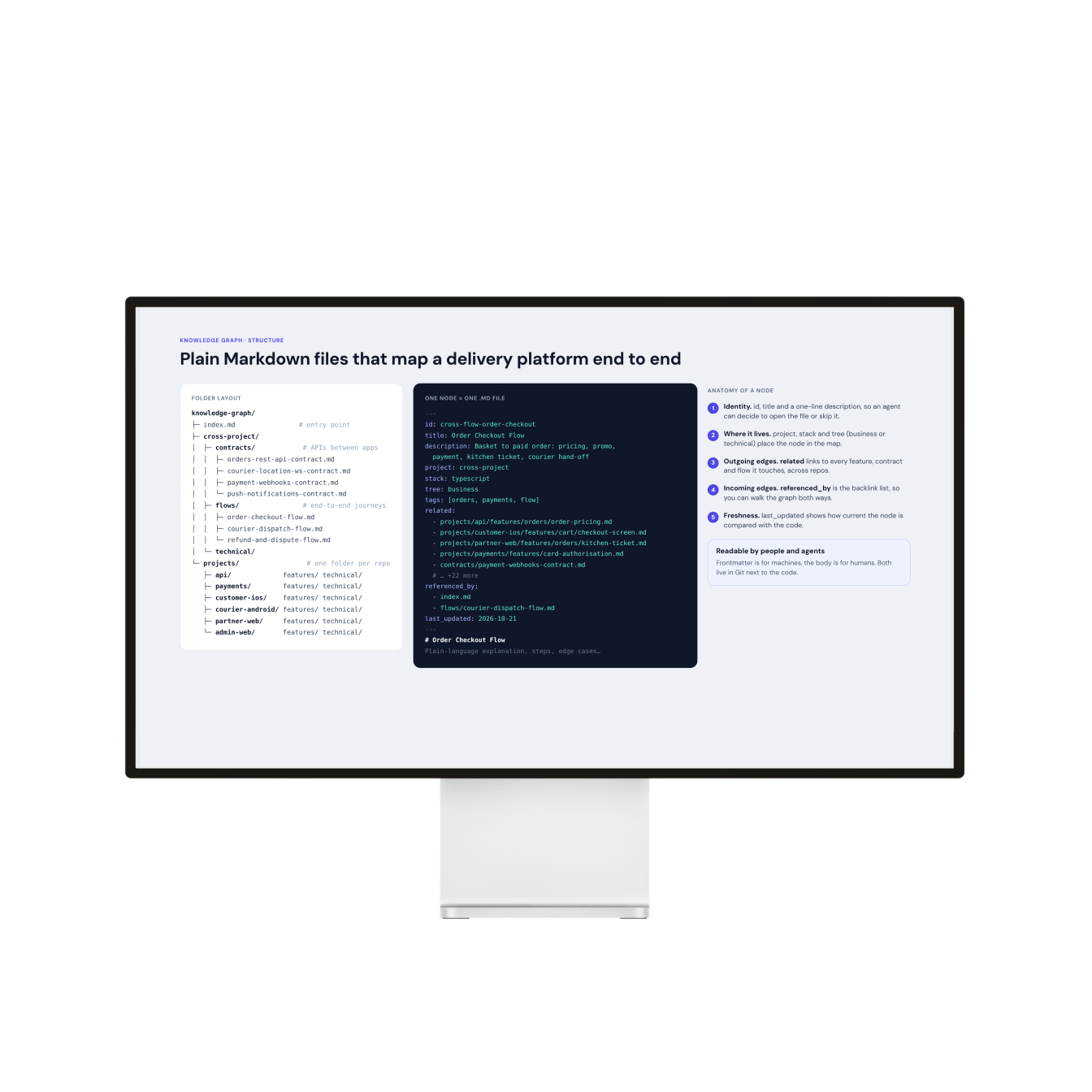
With a single /knowledge-graph command, the skill builds a written map of the whole codebase that both people and agents can read before they change anything. The map is derived from the source code. For each technology stack, the skill gives the agent instructions on what to examine: entry points, API contracts, module dependencies, and where data lives. The agent works through the modules, identifies how the parts connect, and documents those relationships.

‍

In our setup, the result is roughly a hundred small Markdown files covering six projects across four technology stacks. Each file describes a part of the system, such as a feature, a contract between services, or a flow that crosses several applications. It links to related areas and identifies the source files behind the description. The graph is a navigation aid. The code remains the source of truth.

‍

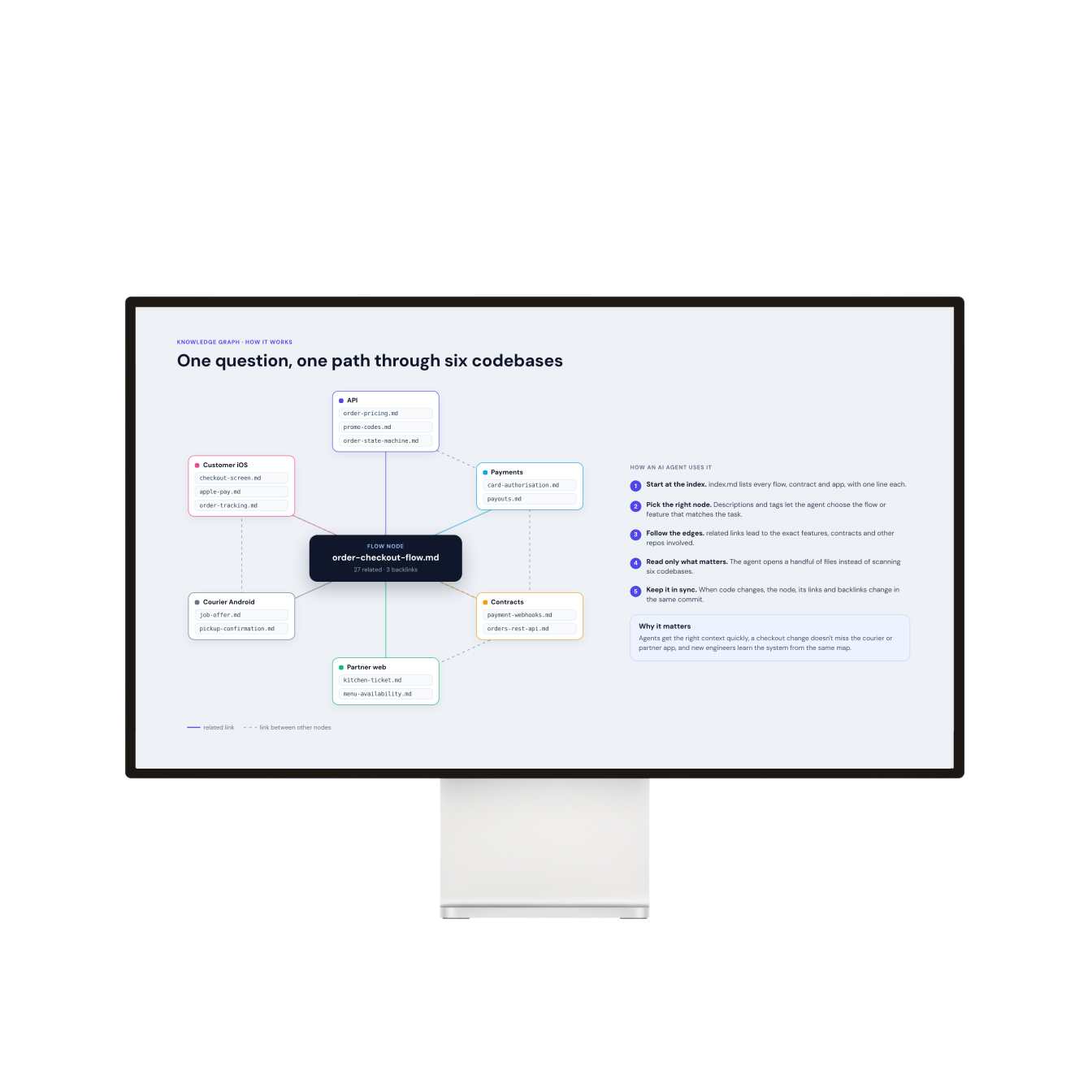
Instead of opening file after file to discover the structure, an agent can read a short overview, follow the relevant relationships, and inspect the source files needed for the task. Lookups are much faster, and more of the agent’s available context goes towards the task itself.

‍

A scheduled GitHub Actions job keeps the graph current. It runs Claude Code against commits since the previous update, rewrites only the affected graph files, and opens a PR for human review. The agent can write only to the graph folder.

‍

Agents consult the graph through a second skill that activates automatically around one question: “Am I about to guess which files to touch, or assume how something works?” If the answer is yes, the agent reads the graph first. That helps prevent an agent from duplicating an existing helper or changing one side of a contract without checking the code that depends on it. It also gives the team a shared way to provide context, rather than leaving each engineer to reconstruct it in a prompt.

‍

What I want AI to improve

‍

AI has also changed how I find and use information. With our knowledge base and tools connected, I can quickly find context across Slack conversations, documentation, and project history, or investigate technical questions around performance, latency, and system behaviour. Together with faster prototyping, this helps me come into discussions better prepared, with concrete ideas, analysis, and working examples.

‍

I believe engineers will gradually spend less time writing and reviewing every individual line, and more time evaluating architecture, interactions between features, and the consequences of technical decisions. How far that shift goes will depend on the quality of the rules, context, and verification supporting it.

‍

«For me, the useful measure of AI today is how much sooner the team reaches a result it can trust.»

Oleh Roshka, CTO & Co-Founder

‍

That requires shared expectations: what a prototype is for, what makes a PR ready for review, where human oversight is needed, and how agents find reliable context.

‍

The tools will change. The team still has to understand and stand behind what it ships.

Found this valuable? Share it forward

Related News

Building Wellness Products That Turn Tracking into Guidance

Digests
November 11, 2026
How Newsoft Helps Nomic Accelerate Its Product Roadmap
Digests
September 8, 2026

All news

Subscribe
to our newsletter

You've successfully subscribed
Oops! Something went wrong while submitting the form.
When you sign up for our newsletter you agree to our Privacy Policy and will receive commerical emails
PAGES
Home
About us
Our Cases
News
Contact
cases
MedPal AI
MedPal AI
LYMA
LYMA
Underdog
Underdog
Virgin Active
Virgin Active
Socials
Instagram
LinkedIn
Clutch
Medium
NEWSOFT, LLC 19–26©

We collaborate with ambitious brands and people.

Legal Terms

NEWSOFT, LLC 19–26©

We collaborate with ambitious brands and people.

Legal Terms

Logo
All News